Search This Blog

Sunday, December 30, 2012

HOW WILL YOU MOVE? WILL YOU USE A MOVING COMPANY, RENTAL TRUCK, OR CALL ON FAMILY AND FRIENDS FOR HELP?


I have three words for you when making this decision: research, research, research. I hear more horror stories about this than any other aspect of moving. Your agent, home stager, or friends or family members may have suggestions for you.

Moving Company
 
There are many options available if you choose to go with a moving company.
Copyright 2008 Chris Breikss Moving Company

Most times, the company will start by sending you a questionnaire or checklist that you complete to describe the details of your move. Most often it’s organized by room and will list items to help you remember everything you have. It will ask you to list the furniture items being moved, as well as the number and size of boxes.

The company will give you a list of items that they will not or can’t move –- either by choice or by law. They will also ask you the address you are moving from to the address you are moving to, which floor you live on (in each place) or how many floors are in the home.

They will also need to know whether you will be packing the boxes and disassembling furniture items or whether you need them to do that as well. All these things affect the price. Believe it or not, some will charge extra if the distance from where they can park the truck to where the entrance to the home is happens to be greater than a certain distance. Prices will also vary depending on how many moving professionals will be needed.

Based on this information, they will give you an estimate. In order to get the most accurate price, make sure to be honest when you complete these forms. If anything, overestimate, rather than underestimate. You’d rather be surprised in a positive way.

Pick a company that specializes in your type of move. If you are moving across the country, find a company that specializes in these types of moves. If you are moving from one small apartment to another, find a mover that offers options for this time of move. Some charge more based on the day of the week. Most have a minimum number of hours they charge for, even if it doesn’t take that long. Pricing will also be affected by where you live and where your new address is in relation to where their company is located. 

Check with the BBB, ask for references (and actually call them) and do online research to look for compliments and/or complaints.

Don’t forget to add a tip amount when budgeting for moving with a company.

Regardless of what route you go, do your research. I can’t possibly explain all the intricacies in a blog article. Read more articles. Then, research individual moving companies, or truck rental companies. Find out whether the final price you are give is indeed the final price, or are there any other potential charges or fees? Find out how payment is accepted, whether there is a discount for cash, if and when a deposit is due, and when the final balance is due.

Ask for references and call them. When you talk to each reference, ask about their experience, whether they would use them again, and whether they would recommend them to a friend or family member. Also ask if they know the company or had a prior relationship with anyone in the company (such as a friend or family member working in the company).

Make sure to find out if the company and its employees have liability insurance, errors and omissions insurance, and how they handle antiques or other valuable items.
Ask them how they book their appointments? How much time do they leave between appointments? If possible, always try to get the first appointment of the day so there’s less chance they can fall behind.


RENTAL TRUCK
 If you have enough help, you may choose to rent a truck and enlist your family and friends.
Copyright 2008 by Phil Gold Budget Moving Company Truck
 
When you rent a truck, you can select the size and any additional tools you might need, such as a hand dolly or belts. No, believe it or not, these are not included in the price and do cost extra.

Once you’ve decided on a truck, you can either enlist the help of family and friends, or find a professional movers. There are both companies that hire out movers and there are also people that do this work as independent contractors.  that work on an hourly basis or by the job, or find experienced movers that work as independent contractors and run their own business.

With truck rentals, ask some of the same questions but also ask if the rental is guaranteed? What type and size truck will you be given? Get everything is writing. Read the fine print on the contract. You don’t want to arrive to get your truck and find out they double-booked and don’t have a truck for you. With truck rentals, if you are hiring independent contractors working as movers, find out the same types of information.

With friends and family, make sure to provide them with some type of food and drink (depending on the time of day and length of the move). If could be coffee and donuts or pizza and soda or other beverages. It might even be move if you’re expecting them to help all day. If you don't provide food or drinks, I would recommend giving some monetary reimbursement as well or a small gift of appreciation.

Tip: You might also need a rental truck if you decide to rent furniture when staging your home.


Recommendations 

So my three absolute recommendations are:
  • First, do research on anything and everything.
  • Second, get anything and everything in writing. Don’t accept anything verbally. Even changes or modifications must be in writing and initialed by all parties involved.
  • Third, take pictures of items you are moving, both before and after the move. Make an inventory of everything you are moving to go with the pictures. For antiques and valuables make sure you have insurance on them with your own policy, and that the movers either have insurance or have a policy that they won’t move these items.
    The actual moving of your belongings can be the most complicated part of the entire moving process. Be as proactive as you can by doing your research, being prepared for moving day, getting everything in writing, and making both a written inventory along with photos and/or video of your belongings. One way you will also make moving easier is if you follow my staging tips and pack those seasonal items or those you don't really use or need for the next month or so -- pack as you are staging.These steps will help you at least minimize the potential for difficulties and problems.

Saturday, December 29, 2012

OUTDOOR STAGING TIPS: SIMPLE TASK YOU CAN DO EACH SEASON


Regardless of the season, there are some things you can do to make your house appealing to buyers. You want those previewinag homes to be impressed enough to make an appointment, and you want those who just happen to drive by your beautiful home to call their agents and ask them to send them the details and make an appointment. If you are really struggling to find or implement ideas, you may want to consider hiring a stager,
Here are some ways to make that positive first impression.

     First of all, while you should always stage all sides of your home, think about the first part buyers will see if they are driving (or walking ) past your home. Most times it’s the front entry area, but it could be the side. Other times, you may be on a corner and buyers may see both one side and the front of the home. Just pay extra special attention to those areas buyers see first. Remember, you always want to play up your home's positive features and downplay any features that aren't so appealing.


Winter

Natural arrangements in nature, like these, don't require any work from you.
Copyright 2007 by Field Outdoor Spaces
  • Clear all pathways
    Make sure all walkways, paths, driveways, and parking areas are plowed, shoveled and de-iced. If you must keep sand or salt out in plain view, at least make sure it’s in a decorative container –- not a plastic bin. Not only is this important for safety reasons, it makes the home look more attractive and it allows showings to occur at any time. It also shows buyers that you take good care of the home.
  • Add some lighting For security reasons, make sure you have lighting on the main pathway to the front door. If you have a long driveway and live in a rural area, add lights to mark the edges of the driveway.
    • If you have a steep driveway, encourage visitors to park on the street (if it’s allowed and safe) and have them walk down the driveway or clear a special path down to the front door from the street. Extra touches like this show buyers you care about their well-being.
    • Also consider adding some uplighting to highlight exterior architectural features or trees. Especially when there is snow on the ground, the light looks great as it glistens off the snow.
    • Keep exterior lights on, even if you aren’t expecting a showing. 
    • Put some interior lights on timers too. Somehow, the lighting makes the house look warm and inviting. 
    • Smoke coming from the chimney of a fireplace or wood stove also adds a nice ambiance.
    • You can even add basic white lights on porches or decks or even on small bushes or trees. Just make sure they don’t make it look like it’s the holidays (if it’s not) and don’t overdo it.
  • Add a sturdy doormat
    Do this both at the exterior of the front door and in the interior. Leave a rubber floor mat for shoes to encourage guests to remove shoes, or offer them plastic foot booties. Both will help keep your house cleaner.
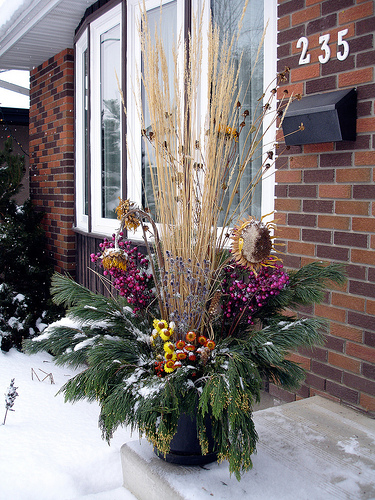
  • Winter arrangements can be just as beautiful as those of spring or summer.
    Copyright 2010 by Daryl Mitchess


  • Add some pots, hanging baskets, or window boxes.
    Fill them with winter arrangements. You can find tons of ideas by doing a search online. Dress up your mailbox the same way. (See photos above and below.)


These outdoor planters look great when they greet buyers at the front door.
Copyright 2007 by Daryl Mitchess 


Spring

Nothing says spring like flowers sprouting from bulbs underground.
Copyright 2007 by Field Outdoor Spaces
 
This is when everything comes to life again -– including buyers looking for homes. Use those cold winter nights to prepare your home for those spring showings if you are getting ready to list.
  • Remove any traces of winter
    Put away snow shovels, and those bags of salt or sand.
  • Remove winter greenery displays.
    Replace pots, baskets, and window box arrangements with spring bloomers.
  • Bring the seating out of storage.
    Bring out those benches or chairs you had by the front door or the chairs and side tables you had on the front porch.
  • Add some spring bulbs around the mailbox or light posts.
    Buy some vines that are already growing and train them around the mailbox or light post.
  • Adding plants and greenery around mailboxes or lamp posts really dresses them up.
    Copyright 2007 by Field Outdoor Spaces

  • Spruce up any wood items that faded with the harsh winter weather. Fences, shutters, and other wood items may have lost some paint or acquired some stains.
  • Fix any damage that was done to walkways or driveways.
    This can be the result of the winter weather, the freezing and thawing, as well as damage done by plow trucks.
  • Start adding a few spring plants here and there.
    You don’t have to do everything at once.
  • The whites and greens look great together, along with some pops of red and yellow.
    Copyright 2007 by Field Outdoor Spaces

  • Look for ways to add color.
    This can be through plants and foliage, new entry mats, or paint on the deck, shutters, porch, or even window boxes and planters.
  • But up bird feeders if you don't have any yet. If you already had some up over the winter, add the seed mixture that attracts those that visit your area this time of year.
  • Put that bird bath back outside.
    If you don't have one, consider getting one. They come in a range of styles and prices to fit any budget -- and you can take them with you when you move.
  • Put pots and planters back out. If you live in a climate with cold winters, many had to be brought inside, such as those made of terracotta, to prevent cracking.
  • Start bringing out patio furniture Clean and repair furniture for your porch, deck, or other outdoor spaces.
  • Begin those spring tasks,
    Pick up sticks and other items blown down by winter storms.Start cleaning up planting beds.

Summer

Summer calls for bright colors that won't fade under the strong sunlight.
Copyright  2007 by Field Outdoor Spaces

  • Replace those spring bloomers.
    Instead, add the more vibrant flower colors of summer. Paler and lighter colors tend to look washed out in the harsh summer sun.
  • Make sure you have some shady areas.
    Show buyers that your yard offers some areas to escape from the direct heat of the sun.
  • Keep up with yard tasks, including cleaning up after pets.
    Keep the lawn mowed, garden beds mulched, and trees and shrubs trimmed.
  • Add some more flowers. Add arrangements in hanging baskets, along with more pots, window boxes, or window seats with planting boxes on the ends.
  • Remember to use lighting to make your home look attractive and inviting
    See some of the suggestions for winter, above.
  • Make sure you show buyers how to use your outdoor space.
    Set up a table and chairs for eating, another area for lounging, and a grill area for cooking for summer barbecues.
  • Water features are another great feature for both spring and summer.
    They provide not only a pleasing sound, but suggest a cooling feeling.   
This water feature made with natural stones provides a relaxing sound for buyers. 
Copyright 2007 by Field Outdoor Spaces


  • Don’t put out too many knick knacks and tchotchkes.
    They look cluttered and lessen the value of the home.


Fall

This arrangement has all the elements of fall, without focusing on a specific holiday.
Copyright  2007 Field Outdoor Spaces
  • Replace your planters, baskets, and boxes with fall flowers.
    There are still plenty to choose from. Twigs and branches with colored leaves are another great option for fall.


This is a great example of a fall arrangement that doesn't use the typical fall items.
Copyright 2007 by Field Outdoor Spaces


  • Keep up with leaf raking.
  • Make sure walkways and driveways are clean and aren’t covered with leaves.
    This is not only appropriate for aesthetics, but slippery leaves pose a slipping hazard.
  • Add fall-themed accents.
    I also recommend to stay away from holiday decorations –- and this goes for any season or holiday -- because that’s too style specific and can offend those that don’t celebrate certain holidays or are turned off by them.
    One example is Halloween. Pumpkins and hay bales, as well as mini gourds are perfectly okay, but stay away from jack-o-lanterns, witches, and ghosts. You may not understand why the potential buyers feel so strongly about a holiday, but why take the chance and offend any buyers? It’s not worth it. (See photo above for a good choice.)
  • Add a welcome mat.
    Choose fall colors or motifs, such as pumpkins.
If you are selling in one season, but want to highlight how your home looks in another, make a photo album showing what your home looks like in other seasons. Get buyers to imagine spending future seasons in their new home. You want to tug at those emotional strings.

Show flowers, trees, and wildlife that you see frequently in your area. For example, there was recently a sighting of a snowy owl less than a ¼ mile from where I live. The owl was just hanging out on the roof of one of the apartment buildings. This would be a great picture to print and put in a frame. Again, pull at those emotions.

This final tip goes for purchasing just about anything. We buy with our emotions and our hearts. We later justify our decisions and choices with reason and our heads.


Wednesday, November 28, 2012

STAGING RESOURCES: BOOKS AND WEBSITES


For those of you who are ready to stage your own home, here are some resources that might help you out. I’ve also written about some of my favorite staging tools in Home Staging Tools


Books

Here are a few great books on staging. If you visit my wish list on Amazon, I have hundreds of books on staging, real estate, and decorating. They are in the categories of Decorating and Design, as well as Real Estate and Home Staging. In the future I hope to separate them out, but for now, you can browse both those lists as well. (Kristen DiNobile is the name it’s under and it is public.) I have read some but not all of these books. New ones are coming out every day as well.
  • The Everything Home Storage Solutions Book: Make the Most of Your Space With Hundreds of Creative Organizing Ideas by Iyna Bort Caruso
  • The Complete Idiot's Guide to Staging Your Home to Sell by Julie Dana and Marcia Layton Turner
  • Home Staging That Works: Sell Your Home in Less Time for More Money by Starr C. Osborne
  • Staged to Sell (or Keep): Easy Ways to Improve the Value of Your Home (Interior Design) by Jean Nayar.
    Notice this title mentions "or keep". Many people stage their homes for living, as opposed to selling.
  • 301 Simple Things You Can Do to Sell Your Home Now and For More Money Than You Thought: How to Inexpensively Reorganize, Stage, and Prepare Your Home for Sale by Teri B. Clark
  • Home Staging For Dummies by Christine Rae and Jan Saunders Maresh
  • Staging Portfolio Secrets: Learn How to Create a Powerful Home Staging Portfolio to Showcase Your Talents and Get Clients to Hire You OR Secrets to Getting Prospects to Instantly Trust You by Barbara Jennings
  • Home Staging 101 (actually a DVD) by Lise Desormeaux.
    NOTE: I have not watched or previewed this yet, but it has gotten great reviews from Amazon customers.
  • How to Sell a House Fast in a Slow Real Estate Market: A 30-Day Plan for Motivated Sellers by William Bronchick and Ray Cooper
  • Home Staging in Tough Times OR How Home Stagers Can Profit from a Real Estate Staging Business in a Down Economy or Any Economy, Even Without Cash by Barbara Jennings
  • Do's and Don'ts in Home Staging and Redesign: 101 Actual Case Studies for Stagers and Redesigners OR How to Learn the Secrets of Arranging Furniture and Accessories From Before and After Pictures By Barbara Jennings
There are tons of books on home staging and selling.
Copyright  2010 by Justin Potca


Websites

  • QC Design School, Home Staging Course
    This is an option if you really want to learn about home staging. I’ve taken this course and others offered by the school. I highly recommend them. They are knowledgeable, professional, well-respected, and reasonably priced.
    QC Design School
  • About.com
    This site has great resources for real estate, buying, selling, and home staging.
    My About.com's home staging site: homestaging.about.com,
    About.com's Home Buying & Selling site: homebuying.about.com.
    Of course there are also other great About sites to help, such as interior decorating, home repairs and improvements, gardening, and budget decorating, just to name a few.
  • Wiki Home Staging
    There is lots of information about selling and staging here.
    Wiki Home Staging
  • Style with Comfort
    First, I need to make a full disclosure. This is my home staging and decorating business website. I do offer services, both online and in-person, but I also have lots of information, resources, and a newsletter (along with this blog).
    Style with Comfort
  • HomeGain
    This site has info on staging statistics and can help you find an agent as well.
    Homegain.com
  • National Association of Realtors (NAR)
    They have numerous articles, tips, and statistics on staging.
    NAR
  • HGTV
    The website has tons and tons of info, including articles, pictures, tips, tricks, before and after shots, and of course, TV shows. Most recently, they started publishing a magazine through Hearst. They also have companion sites, such as HGTV's Front Door, dedicated to real estate.
    HGTV
    HGTV's Front Door.
  • Better Homes & Gardens
    While best known for their magazine, they also have lots of information, articles, tips, tricks, and pictures on their website, with sections about staging and real estate -- anything related to the home and garden.
    Better Homes & Gardens
  • Home Staging Online
    This site has lots of resources and information, as well as Brooks Furniture Rental Services.
    Home Staging Online
  • Real Estate Staging Association (RESA)
    This professional association has everything you need to know about home staging and real estate.
    RESA
  • Furniture Rental Companies
    There are way too many to list and most are local, so it’s difficult to give an overall list that will benefit everyone across the country. Just do a search on your favorite search engine and make sure you research the companies and get references from former clients. You can also ask your agent or home stager.
    Renting furniture can be really helpful when you just don't have the proper furniture for staging one or more rooms. Many people don't have their kitchens (especially eat-in kitchens) or dining rooms staged for their typical uses and furniture can really help show buyers how to use the space.
Browse the above sites or search for others to find lots of additional information.
Copyright  2008 TopRankOnlineMarketing

As home staging continues to increase in popularity, more and more information and resources are appearing. This list should be enough to get you started if you wish to learn more about home staging.

STAGING PICTURES: WHAT TO TAKE AND WHAT TO AVOID


It’s important to remember that over 90% of buyers see your home for the first time on the Internet. Here, pictures really are worth a thousand words.


Here are some of my pet peeves with pictures I’ve seen:

  • Dark pictures.
    Take the time and do it right or don’t do it at all.
  • Pictures that aren’t really showing anything.
    Okay, it’s a corner of the room? What’s there? Why do I want to see it?
  • Bathroom pictures without a focus (or the wrong focus).
    Please keep the toilet seat down. Why would you take a picture with the seat up? And why would you take a picture specifically of the toilet? Now obviously, you are going to see the toilet in pictures, but make sure the seat is down and take a picture of the whole bathroom -- or as much of it as you can.
  • Pictures that aren’t genuine or truly representative of the home.
    Don’t post pictures of what your house used to look like when it was newer or in better condition. This only aggravates and frustrates buyers when they get there.
  • No pictures.
    When you don’t post pictures, people wonder what’s wrong with the home. Are you afraid to show pictures? Their other thought is that the agent or sellers just don't care.
  • Pictures that show dirty or cluttered rooms.
    First, that shows owners don't take care of their home. It could also give the impression that they don't care about the home or the selling process. Take the time to clean the home properly before taking pictures.
This picture does nothing to draw buyers to see this home.
Copyright  2007 by Michael Janssen


Okay, now here’s what you should do.

  • Focus on the home’s positive features.
    If you have a gorgeous fireplace, make sure to include it -– both a close-up detail and a broad picture of how it looks in the space.
  • Avoid negative features or fix them before taking pictures.
    If you’re bedroom is cluttered, the bed is unmade, and there are clothes all over the floor -– which shouldn’t be the case if you staged your home –- wait until it’s clean to take the pictures. The same goes for a kitchen with a sink full of dirty dishes. What about your home's color palette? Is is too strong or personal, or is it a good staging palette -- meaning it appeals to a wide range of buyers?
  • Accentuate the positive.
    If you have amazing views, take pictures of them.
  • Don’t be afraid to include pictures of bathrooms.
    Sometimes when people don’t see pictures of bathrooms or kitchens, they assume the spaces must be outdated or just plain ugly.
  • Take close-ups shots of special features.
    If you have gorgeous glass tiles on your backsplash or original hardwood floors, take pictures of them. People love details like this. Do you have amazing architectural features, like cathedral ceilings or crown moldings? Details can tug at emotional strings -– just what you want.
  • Include pictures of both the inside and the outside.
    People like to see what a home looks like, especially the curb appeal shot. And they always like to see what the backyard looks like. Don’t forget these pictures.
If you saw this picture on the Internet, would you want to visit this home?
Copyright 2012 by Highland Homes


Every picture you post on your home’s listing page should be one you’d be proud to show others. If you are embarrassed by them or look at them and think, “I wouldn’t go see this house based on these pictures,” then it’s time to retake them. It’s okay to ask your agent to redo the pictures. Or, if you or someone you know is a great photographer, ask them either for tips or to take the pictures for you. You can also do a virtual tour. Ask you agent about this. There are several options for doing this.

If you are selling a very expensive home, it pays to have a professional photographer come in and do not only photos, but also a virtual tour.

An expensive home like this requires impeccable pictures and possibly a virtual tour.
Copyright 2009 by Mike Whaling


In general, ask yourself what pictures you would like to see when looking at a home? What would you not like to see? If your pictures are already up, ask friends or family members to give their honest opinions. Have you noticed by looking at online pictures that you can tell whether the sellers have taken the time to stage their home? Pictures clearly show the difference between homes that are staged and those that have not been staged.
Pictures are usually the first view buyers get of your home, so make sure you take the time to make them impressive. Pictures should make buyers want to see more.

STAGING ENTICEMENTS: WHAT YOU CAN OFFER BUYERS TO MAKE YOUR HOME STAND OUT


Many people ask me if there is anything they can do to make their home more attractive to buyers, to entice buyers to come and see the home.  Here are a few ideas that many agents and clients have tried over the years. There are no statistics about whether or not they work, but it can’t hurt to try one or more of them.
  1. Offer to pre-pay certain bills.
    For example, you can pay a certain number of months, or a full year, of one of the household bills. Some condo owners offer to pay for 6 months or a year of HOA fees. You can make it contingent on a full price offer. Think about it. It probably costs less to pay for those fees than to take a lower priced offer. Other options include paying for a year of gardening services, a year of cable bills, or even a few months of property or school taxes. People like to get things for “free” and it ultimately doesn’t cost you any money because you’ll either get that full price offer (as opposed to a lower one) or you’ll sell the home quicker.
  2. If you have really nice landscaping, consider including the cost of 6 months or a year of landscaping services for the new owners.
    Copyright 2007 by Aunt Owwee

  3. Perform a pre-inspection on the home.
    Now, buyers will still usually do their own inspection but it might help them feel secure about making an offer. It benefits you because it calls attention to any potential problems that might pop up later and potentially derail the sale.
  4. Include a home warranty with the sale of the home.
    Usually it’s a 1-year warranty. Various companies offer them and they cover certain major features or systems of the home. If something happens, the new owners just pay a deductible, just like you do with car and home insurance, and the repair is covered. Just do your research and make sure you understand what is and is not covered. The good part is you don’t have to pay for it until closing. And, as an added benefit, it helps avoid problems resulting from that last minute repair that always seems to pop up the day before closing. With the warranty, it’s covered. Problem averted! Some sellers are hesitant to pay the extra cost but if it helps you sell quicker, it might save you money in the long run and might bring in more buyers and better offers because people feel a little bit more secure that if something goes wrong, they won’t be out lots of money.
  5. Offer to pay some of the closing costs.
    Just make sure to put a cap on the amount. Closing costs add up quickly.
  6. Include certain items or give gifts.
    For example, you can include furniture items. Just make sure they are in good condition. Otherwise, you're better off selling them at a garage sale or donating them. You can even offer gift cards to retail stores that sell home products (like Target or JC Penney) or home improvement stores. Some sellers just buy products like a flat screen TV and include them in the sale. If you compare the cost of these gifts (a hundred or a couple hundred dollars) with the amount of a lower price offer (thousands of dollars), you can see it is well worth it. People will usually feel guilty offering a much lower asking price if you include these items. It also draws traffic into your home. More buyers viewing the home means a better chance of an offer. 
Some sellers offer gift cards to potential buyers.
Copyright  2012 by 401(K)2012


These are just a few ideas, but get creative and think of your own. Think about your state, area or region. Also, consider the price of your home. A $100 gift card is not going to entice buyers of a multi-million dollar home, but would be much appreciated by buyers of homes in the average price range, say around $200,000. Lastly, know your target buyers. What would they would want or enjoy?

STAGING REPAIRS: WHEN TO CALL IN THE PROS


Unless you are a licensed contractor, electrician, or other professional, some projects are not best for homeowners to do on their own. First of all, there's the possibility of serious injury. Second, there's a chance the work won't be done properly or to code. And finally, if you perform work and there is later a problem that causes damage to your home as a result of the work, your insurance may refuse to cover the cost of repairing your repair! Here are just a few projects that the average DIYer should leave to a professional.
  • Electrical Work
    If you are an experienced DIYer, you may be able to tackle hanging a light fixture if it’s a simple replacement. Other than that, call in a professional. Why? Many people don’t realize that if a fire starts and it’s determined to be a result of your work, your insurance company will most likely refuse to cover the damage. You could lose your entire home. You could also severely injure yourself.

  • Always call in a professional electrician anytime you need electrical work done in your home.
    Copyright 2000 by Chris Hunkeler
  • Major Plumbing Work
    This can just be too complicated for the average homeowner.
  • Septic
    Do you really want to dig up your lawn to find the problem? Also, major projects may require special equipment that you don't have.
  • Sheetrock and Drywall Work
    While these aren't dangerous jobs, they are very difficult to do properly. Professionals can do it much quicker and with much better results. Getting straight lines without any bumps or cracks is very difficult for the average person. Corners can also be hard to do properly. Even some general contractors will call in drywall experts to do this part of the work.
  • Roofing
    Roofing work can be complicated and if not done properly can lead to leaks and other problems. Plus, climbing up on a ladder and walking on a roof are dangerous for those that are not experienced.
Roofing is another job that should always be left to professionals.
Copyright 2010 by Tony Alter


Overall, whether they are potentially dangerous or just require a specific skill set, these jobs are best left to professionals who do this work on a daily basis. You're get quicker and more professional results if you use their services.

QUESTIONS TO ASK PROFESSIONALS BEFORE HIRING THEM


When you need to hire a professional, you should have a detailed list of questions to ask them. Some of these are general and can be applied to any professionals you may hire, but many are geared at contractors and home inspectors, who may be an important part of your staging team.
    General Questions
  1. What are your qualifications?
  2. How long have you been in this profession?
  3. How long has this company been in business?
  4. Can I have your complete contact information, including phone, fax, email, and website?
  5. Would you be willing to give me a list of referrals that I can call?
  6. Do you have pictures of your work or testimonials?
  7. What training have you had? Do you participate in continuing education?
  8. Are you a member of any professional associations?
  9. Have you ever had any problems or difficulties with any clients in the past? What were they? Were they resolved, and if so, how?
  10. Will you be giving me an itemized estimate of the costs?
  11. Can you give me a detailed list of the products you will be using (name and product numbers)?
  12. What is your fee schedule? Do you require a down payment? When is the balance due?
  13. Are you licensed and insured? Do you have errors and omissions insurance?
  14. What is your warranty on your work?
  15. How will you get rid of the garbage and debris? Is that included in the estimate?
  16. What is your policy for cleaning up each day?
  17. What is the estimated time for completion?
  18. What potential delays do you forsee? How will you handle these?
  19. Who is responsible for getting permits or COs for the job?
  20. Will you be employing any subcontractors? Who are they and what are their qualifications?
Some Final Tips
  • Interview at least 3 professionals.
  • Always check references.
  • Do research for complaints and check the Better Business Bureau. Another site is RipOff Report.
  • If the person is a member of a professional association for their trade, verify this with the association. Also, verify that they are in fact licensed and insured. Do the same thing for any subcontractors.
  • If it’s a contractor or someone who’s work is visible, it’s okay to ask if you can see some of their prior work in person.
  • Take all factors into account. Don’t always go with the highest or lowest price. The lowest price may include materials of lesser quality. The highest price could just be inflated and they still may be using lower quality products and pocketing the extra money as more profit. This is not always the case. I have come across some good, honest contractors that I would highly recommend and use again.
  • Make sure you get a detailed estimate so you can compare apples to apples.
  • Don’t discount the importance of personality. You are going to be working closely with this person and if you don’t get along, it’s not going to be a very pleasant process. Many people think they should just be looking at the quality of the work. While that is important, so is personality. Trust me on this one. The quality work won’t mean anything if you don’t get along and the project never gets finished.
  • Warning: Don’t ever, ever, ever pay a contractor or any professional in full before the work or job is completed.


Always get everything in writing when dealing with any professionals -- individuals or companies.
Copyright  2009 by NobMouse


These are general questions and are mostly geared towards professionals like contractors, specialty contractors, and home inspectors. Many of them are general enough to be used for hiring any professional. Many people are starting to use home staging as a way to live in their homes, with no intention to sell, so they may need these professionals to make repairs or updates.

There are specific questions I recommend asking professionals such as real estate agents and home stagers, which I'll discuss in a future blog post. But use these questions as a guide to get your started. Above all, trust your gut and your instincts.